Best Shades for Florida Sunlight: A Pinecrest Homeowner’s Guide
Learn which shades work best for Florida sunlight, heat, glare, privacy, and UV exposure—and how Pinecrest homeowners can choose the right solution.
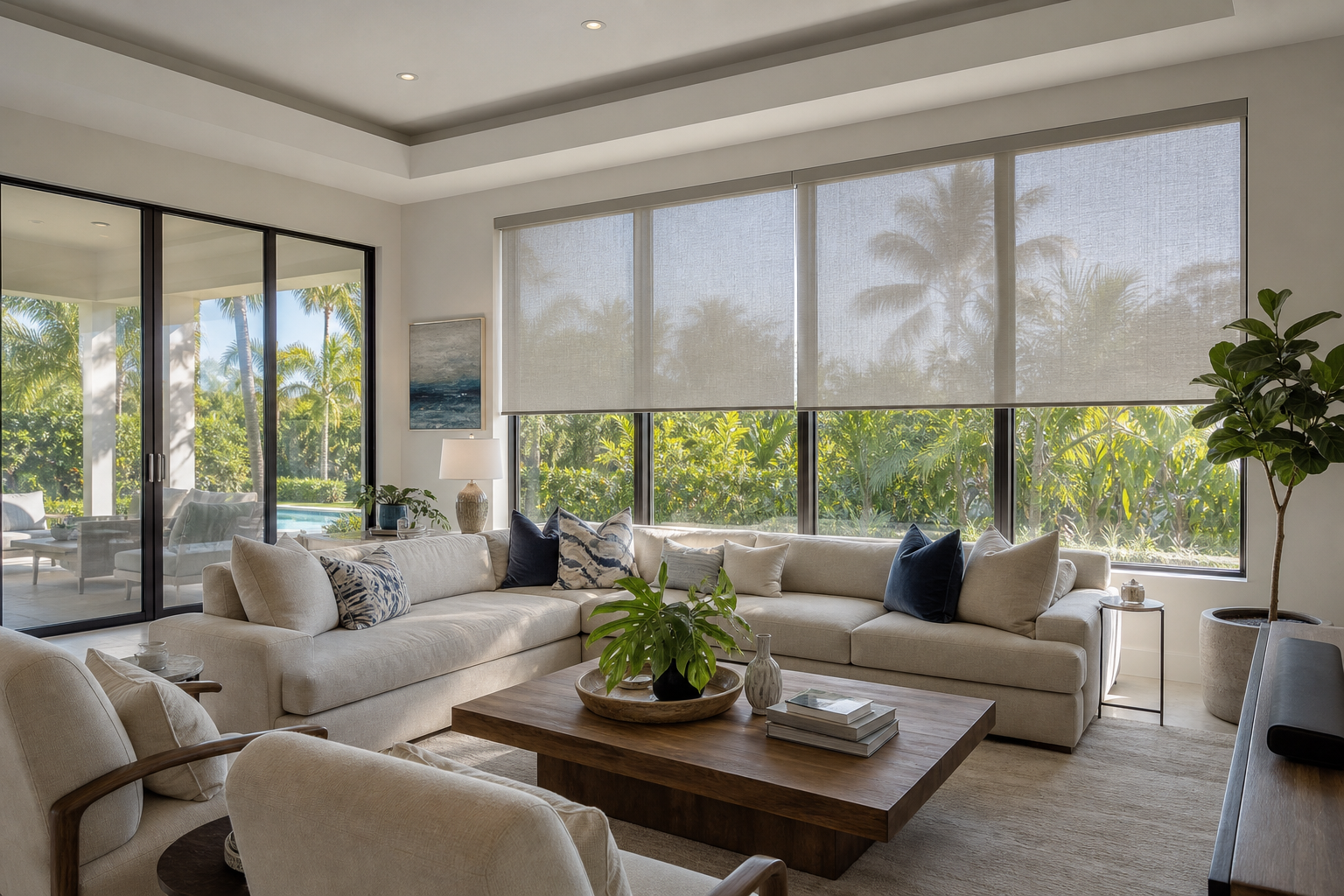
Finding the best shades for Florida sunlight is not only a design decision. In Pinecrest and throughout South Florida, intense sun, heat, glare, and year-round UV exposure can affect how comfortable a room feels and how well furnishings hold up over time. The right window treatment should help you manage light while complementing your interior and fitting the way you use each room.
There is no single shade that is ideal for every window. A sunny living room may benefit from solar shades, while a bedroom may need blackout shades for stronger light control. Zebra shades, roller shades, and motorized options can also be effective when selected according to the room’s orientation, privacy needs, and daily routine.
This guide explains how the most popular shade styles perform in Florida sunlight and what Pinecrest homeowners should consider before choosing custom window treatments.
What Makes Florida Sunlight Challenging?
South Florida homes receive strong sunlight for much of the year. Windows facing east may receive bright morning sun, while west-facing windows can experience intense afternoon heat and glare. Large windows and sliding glass doors create additional challenges because they allow more light into the room and can be difficult to cover with standard-size treatments.
Florida sunlight can affect a room in several ways:
- Glare: Bright reflections can make televisions, computers, and work surfaces harder to use.
- Heat: Direct sunlight can make rooms feel warmer, especially near large windows or glass doors.
- UV exposure: Prolonged sunlight may contribute to fading on flooring, furniture, artwork, and fabrics.
- Privacy concerns: Homes with street-facing windows or close neighboring properties may need daytime and nighttime privacy.
- Uneven lighting: Uncontrolled sunlight can create bright spots and high contrast throughout a room.
Custom shades allow you to address these issues window by window rather than using the same product throughout the entire home.
Best Shade Options for Florida Sunlight
The best choice depends on whether your main priority is reducing glare, blocking light, preserving a view, improving privacy, or creating a more comfortable room. The following shade styles are commonly considered for South Florida homes.
Solar Shades for Glare, Views, and UV Control
Solar shades are designed to filter sunlight while maintaining some visibility through the window. They are often a strong option for Pinecrest living rooms, home offices, dining areas, and other spaces where you want to reduce glare without completely losing the outdoor view.
Solar shades can help soften direct sunlight and reduce the visual discomfort caused by bright windows. They are especially useful for rooms with televisions or computer screens. The openness of the shade fabric affects how much light, privacy, and view-through you receive, so the appropriate selection should be based on the window’s location and the room’s use.
Keep in mind that solar shades are not typically intended to create a fully dark room. At night, when interior lights are on, privacy can change because the room may become more visible from outside. Layering or pairing them with another window treatment may be appropriate when nighttime privacy is important.
Blackout Shades for Bedrooms and Media Rooms
Blackout shades are a practical choice when the goal is to block as much incoming light as possible. They are commonly used in bedrooms, nurseries, guest rooms, and media rooms where bright Florida sunlight can interfere with sleep, relaxation, or screen visibility.
Blackout performance depends on more than the shade material alone. Light can still enter around the sides, top, or bottom of a window depending on the installation and window configuration. Professional measurement helps determine how the shade should be fitted for the level of light control you want.
For a Pinecrest bedroom with strong morning sunlight, blackout shades can make the space more comfortable for sleeping. Motorization can also make it easier to adjust the shades without getting out of bed or disturbing the room.
For more ideas about automated bedroom window treatments, see Smart Blackout Shades for Bedrooms.
Roller Shades for a Clean, Versatile Look
Roller shades are a straightforward and adaptable option for many rooms. Their simple profile works well with modern interiors, and they are available in fabrics designed for different levels of light filtering, privacy, and room darkening.
Because roller shades can be customized for the purpose of each room, they may be used throughout a home without creating a mismatched appearance. A light-filtering fabric may work well in a bright living area, while a room-darkening fabric may be more suitable for a bedroom or media space.
Roller shades are also a useful option for windows where you want a neat appearance when the shade is raised. As with other shades, the fabric and fit should be selected based on sun exposure, window size, and privacy requirements.
Zebra Shades for Flexible Light Control
Zebra shades use alternating bands of solid and sheer fabric to provide adjustable light control. By aligning or overlapping the bands, you can change the amount of light entering the room and adjust privacy throughout the day.
This flexibility can be useful in Pinecrest homes where a room serves multiple purposes. You may want filtered daylight and an outdoor connection during the day, followed by more privacy in the evening. Zebra shades offer a modern appearance while allowing more adjustment than a simple open-or-closed treatment.
They are not the same as blackout shades, so they may not be the first choice when your main objective is maximum darkness. However, they can be a good fit for living rooms, dining rooms, and bedrooms where variable light control is more important than complete room darkening.
Read more about this option in Smart Zebra Shades for Living Rooms.
Motorized Shades for Convenience and Sun Management
Motorized shades can be helpful when windows are large, high, difficult to reach, or installed across several rooms. Instead of adjusting each shade manually, you can operate them from a control, depending on the selected system.
In a Florida home, motorization can also support a consistent daily routine. Shades may be opened in the morning, adjusted during the brightest part of the day, and closed later for privacy. This can be particularly convenient for homeowners who spend part of the year away from the property or want easier control of multiple windows.
Automation should be planned around the home’s actual needs. Consider which rooms receive direct sun, how often you want to adjust the shades, and whether accessibility or child safety is a concern. A professional consultation can help determine where motorization provides meaningful value rather than adding unnecessary complexity.
For a broader look at the decision, visit Are Smart Shades Worth It?
How to Choose the Right Shades for Each Room
Rather than choosing one shade style for the entire house, evaluate each room separately. The same sunlight that makes a living room bright and inviting may be disruptive in a bedroom or home office.
| Room or space | Common priority | Shade options to consider |
|---|---|---|
| Living room | Glare reduction, filtered light, design | Solar shades, zebra shades, light-filtering roller shades |
| Bedroom | Privacy and stronger light control | Blackout shades, room-darkening roller shades, motorized shades |
| Home office | Reducing screen glare while preserving daylight | Solar shades, light-filtering roller shades |
| Media room | Minimizing incoming light | Blackout shades or motorized blackout shades |
| Dining area | Flexible privacy and appearance | Zebra shades, roller shades, solar shades |
| Large windows or glass doors | Consistent coverage and easy operation | Motorized roller shades, solar shades, or coordinated custom shades |
Important Considerations for Pinecrest Homes
Window direction and time of day
Pay attention to when sunlight enters each room. East-facing windows may need morning light control, while west-facing windows often require more attention during the afternoon. A shade that works well in a north-facing room may not provide enough glare control on a west-facing window.
Privacy during the day and at night
Privacy needs change depending on lighting conditions. Some fabrics provide daytime privacy while still allowing a view outside, but that balance may change after dark when interior lights are on. Discuss both daytime and nighttime privacy before selecting a fabric.
Large windows and sliding doors
Large openings often need more than a standard off-the-shelf solution. The treatment should operate smoothly, fit the opening properly, and coordinate with the surrounding architecture. Motorized shades may be worth considering when the shades are wide, tall, or used frequently.
Interior design and fabric selection
Color, texture, and opacity all affect the finished result. Lighter fabrics may help maintain an airy appearance, while darker or denser fabrics can provide stronger visual contrast and light control. The right choice should complement flooring, wall color, furniture, and the amount of natural light already in the room.
Professional measurement and installation
Accurate measurement is important for appearance and performance. Windows may vary slightly from one another, and recessed frames, trim, handles, and door clearances can affect the installation. Professional measurement helps identify these details before the shades are ordered.
Installation also matters, particularly for large windows, motorized products, and shades that need to align across multiple openings. A coordinated installation can create a cleaner appearance and make sure the shades operate as intended.
Can Shades Help With Heat and Energy Use?
Window shades can help reduce the amount of direct sunlight entering a room, which may improve comfort near sunny windows. Solar shades and other light-filtering options can soften sunlight, while blackout and room-darkening shades can limit incoming light more substantially.
Results depend on factors such as window orientation, glass type, shade fabric, fit, and how consistently the shades are used. Shades should be viewed as one part of a home’s overall approach to managing heat and sunlight, not as a substitute for every other building feature.
Questions to Ask Before Buying
- Which windows receive the strongest direct sunlight?
- Do I need filtered daylight, privacy, or near-darkness?
- Will the shades be used for television viewing or computer work?
- Do I need the same appearance throughout the home?
- Are any windows too high, wide, or difficult to reach for manual operation?
- Would motorization make daily use more convenient?
- How will the shades perform during the day compared with nighttime?
Frequently Asked Questions
What are the best shades for strong afternoon sun in Florida?
Solar shades, room-darkening roller shades, and blackout shades are common options for strong afternoon sun. The right choice depends on whether you want to preserve the view, reduce glare, or block as much light as possible.
Are solar shades suitable for bedrooms?
Solar shades can work in bedrooms when filtered daylight and an outside view are priorities. If you need stronger nighttime privacy or a darker room, blackout or room-darkening shades may be more appropriate.
Do blackout shades block all light?
Blackout shades are designed to provide substantial light control, but light may still enter around the edges depending on the window, mounting method, and installation. Professional measurement can help reduce unwanted gaps.
Are zebra shades a good choice for sunny living rooms?
Zebra shades can be a good choice when you want adjustable light and privacy throughout the day. They offer flexibility, although they may not provide the same level of darkness as a dedicated blackout shade.
Should I motorize shades in a Pinecrest home?
Motorization may be useful for large, high, or hard-to-reach windows, as well as homes with several shades that need frequent adjustment. A consultation can help identify which windows would benefit most.
Choose Shades Based on Your Home’s Light and Lifestyle
The best shades for Florida sunlight are the ones that match the specific conditions of your home. Pinecrest homeowners may need to balance glare control, privacy, heat, design, and ease of use across several different rooms.
Floridian Blinds can help you compare solar shades, blackout shades, roller shades, zebra shades, and motorized options for your windows. Contact us for a free consultation and measurement to discuss your sunlight, privacy, and design goals.