Solar Shades and Nighttime Privacy: What South Florida Homeowners Should Know
Solar shades help manage glare, heat, and UV exposure, but their privacy performance changes after dark. Learn how solar shades work at night and how to choose the right window treatment for your South Florida home.
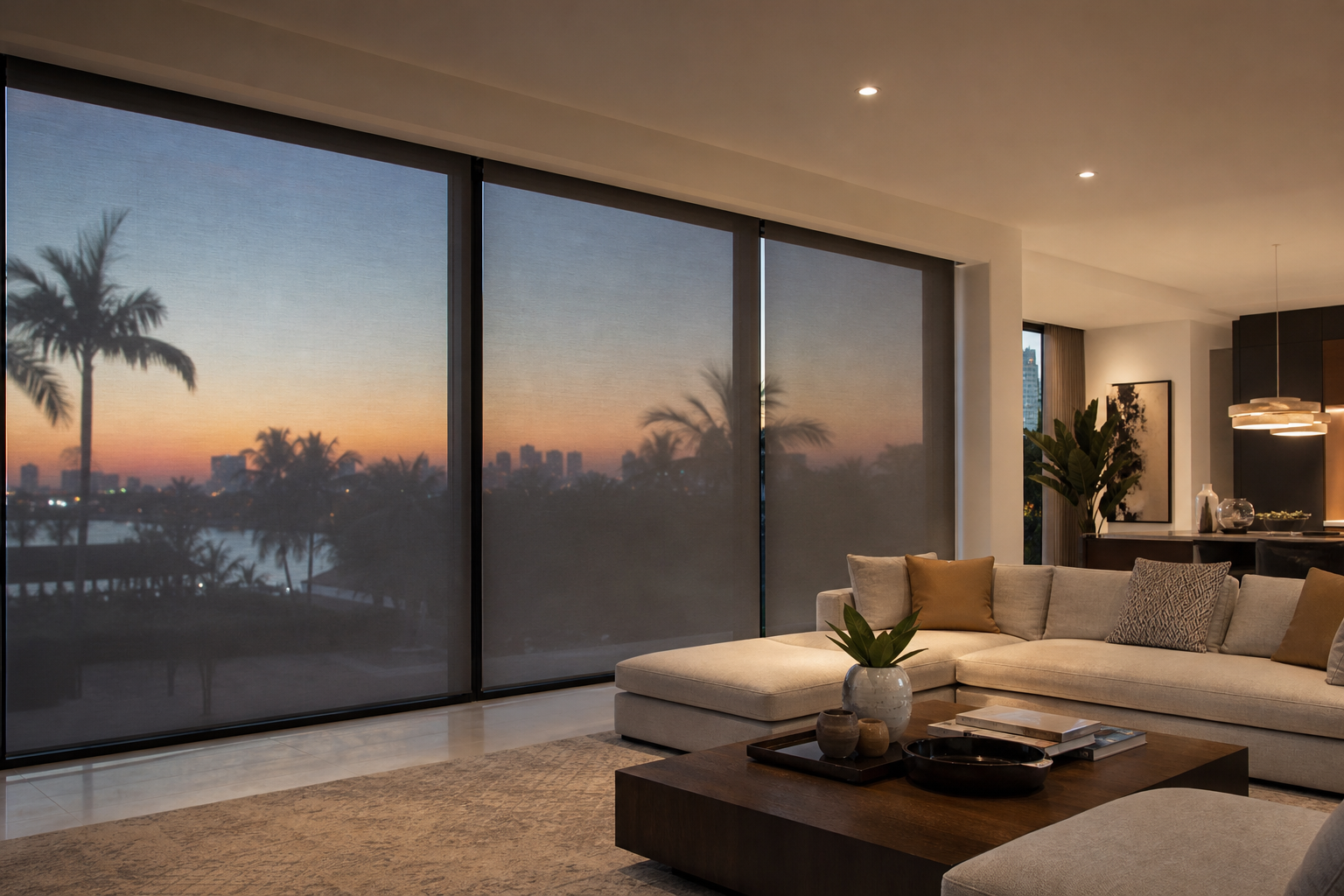
Solar shades are a popular choice for South Florida homes because they help soften intense sunlight, reduce glare, and protect interiors from daily UV exposure while maintaining an open, modern appearance. They are especially useful for large windows, glass doors, condos, and rooms with views of the outdoors.
One question homeowners often ask is whether solar shades provide privacy at night. The answer depends on lighting conditions. Solar shades can offer useful daytime privacy when the outdoors is brighter than the room, but the privacy effect changes after sunset. Understanding this difference can help you choose the right window treatment for bedrooms, bathrooms, living areas, and street-facing windows in Miami-Dade County.
This guide explains how solar shades and nighttime privacy work, what affects visibility through the fabric, and when to consider layering solar shades with another treatment.
How Solar Shades Provide Privacy During the Day
Solar shades are made with screen-like fabric that filters sunlight before it enters the room. Their openness factor, fabric color, and the difference between indoor and outdoor lighting all affect how much you can see through the shade.
During the day, outdoor light is typically stronger than indoor light. When the shade is lowered, people outside may see a softened view of the window or a general outline, while those inside can often maintain some visibility toward the exterior. This makes solar shades useful for:
- Living rooms facing a street or neighboring property
- Large windows with attractive outdoor views
- Home offices where glare affects computer screens
- Dining areas and open-concept spaces
- Condos and apartments with bright exposures
This daytime privacy effect is not the same as full privacy. A person standing close to the window may still see more than someone farther away, particularly when the shade uses a more open fabric. Solar shades should be selected based on the level of privacy you need, not just their appearance from inside the room.
Why Solar Shades Do Not Provide the Same Privacy at Night
After sunset, the lighting relationship reverses. Interior lights make the room brighter than the outdoors, so the window can become more visible from outside. Depending on the fabric and viewing angle, someone outdoors may be able to see silhouettes, movement, or details inside the room.
This is the most important limitation to understand when considering solar shades and nighttime privacy: closing a solar shade does not necessarily create a private room after dark. The fabric may reduce visibility, but it is not designed to function like a fully opaque or blackout shade.
Nighttime visibility can be more noticeable when:
- The room has bright overhead lighting
- The window faces a sidewalk, driveway, pool area, or neighboring home
- The shade has a more open weave
- People outside are close to the glass
- The interior has light-colored walls or furniture near the window
For rooms where nighttime privacy is essential, homeowners may need a secondary window treatment or a different type of shade altogether.
What Affects Solar Shade Privacy?
Openness factor
The openness factor describes how tightly the fabric is woven. A lower openness factor generally means the fabric has smaller openings and provides more light filtering and daytime privacy. A higher openness factor usually preserves more outward visibility and natural light, but it may provide less privacy.
There is no single openness factor that works for every room. A living room overlooking a private backyard may benefit from preserving the view, while a bedroom facing a busy street may need a tighter weave or an additional privacy layer.
Fabric color
Fabric color also affects how solar shades look from inside and outside. Darker fabrics can often reduce glare and preserve outdoor views more comfortably, while lighter fabrics can create a brighter appearance. The right choice depends on the room’s orientation, interior design, and desired level of light control.
Color alone, however, does not determine nighttime privacy. Even a darker solar shade may allow views into a brightly lit room after sunset if the fabric is not opaque.
Window location and viewing angle
A window on an upper floor may have different privacy needs from a street-level window. The height of the glass, nearby landscaping, neighboring buildings, and the direction from which people approach the home all matter.
In a Miami Beach condo, for example, the main concern may be visibility from another building. In a single-family home in Pinecrest, Coral Gables, or Kendall, privacy may be more important along a front-facing window or patio door. A professional consultation can help account for these sightlines instead of evaluating the fabric in isolation.
Interior and exterior lighting
Privacy is ultimately influenced by contrast. When the exterior is brighter, solar shades generally provide better daytime privacy. When the interior is brighter, visibility from outside increases. This is why a shade that appears private in a showroom or during the afternoon may perform differently at night in your home.
Are Solar Shades a Good Choice for Bedrooms and Bathrooms?
Solar shades can work well in bedrooms and bathrooms when their light-filtering and privacy capabilities match the room’s needs. However, bedrooms often require more nighttime privacy than a solar shade can provide by itself. If the room faces a neighboring property, street, or shared walkway, consider pairing the solar shade with an opaque shade, drapery, or another room-darkening layer.
Bathrooms require careful attention to privacy, especially when windows are near eye level or face another home. A more private fabric or a dual-shade arrangement may be more appropriate than an open solar screen. The goal is to balance daylight, ventilation, design, and privacy without relying on a shade that was not intended to provide complete coverage after dark.
Ways to Improve Nighttime Privacy With Solar Shades
Layer solar shades with a privacy or blackout shade
Layering gives you more control throughout the day. A solar shade can remain lowered during daylight hours to reduce glare and filter UV exposure, while a second shade can be closed at night for greater privacy and light control.
This approach is useful in primary bedrooms, media rooms, nurseries, and street-facing living spaces. For rooms where darkness matters, you can learn more about how blackout shades can support light control and heat management.
Use curtains or drapery as a second layer
Drapery can add a softer design element while improving nighttime privacy. It can also help frame large windows and sliding glass doors. When combined with solar shades, curtains allow you to keep the shades lowered during the day and close the fabric layer when the room needs more privacy at night.
Choose motorized operation
Motorized shades make it easier to manage privacy consistently, particularly for large windows, high ceilings, or multiple rooms. You can lower the shades before sunset or close a second layer when indoor lights are turned on. Motorization can be especially convenient for homeowners who want a simple routine for bedrooms, living areas, and hard-to-reach windows.
For homeowners exploring automated light and heat management, Floridian Blinds also provides guidance on smart shades for South Florida homes.
Use lighting strategically
Window treatments are only part of the privacy solution. Bright lights directly beside a window can make interior activity more visible. Using layered lighting, placing lamps farther from the glass, and closing the shade before turning on strong interior lights may help reduce the feeling of exposure.
Solar Shades Compared With Other Window Treatments
Solar shades are often selected for their clean appearance, glare reduction, and ability to preserve a connection with the outdoors. Other window treatments may be better suited when nighttime privacy or room darkening is the primary goal.
| Window treatment | Daytime performance | Nighttime privacy | Common use |
|---|---|---|---|
| Solar shades | Filters glare and sunlight while maintaining some outward visibility | Limited when indoor lights are brighter than outdoors | Living rooms, offices, large windows, and view-oriented spaces |
| Blackout shades | Provides strong light control when closed | More suitable for privacy after dark | Bedrooms, media rooms, and rooms needing darkness |
| Roller shades | Available in different fabric opacities and privacy levels | Depends on the selected fabric | Flexible room-by-room applications |
| Zebra shades | Adjusts between filtered light and a more closed position | Privacy depends on the configuration and fabric | Modern interiors requiring adjustable light control |
| Drapery | Can filter or block light depending on the fabric | Can provide added coverage when fully closed | Layering, large windows, and decorative interiors |
The best solution may involve different treatments in different rooms. A home office may benefit from solar shades, while a bedroom may need blackout coverage. An open living area may use solar shades during the day with drapery for evening privacy.
How to Choose Solar Shades for a South Florida Home
Identify the main problem. Decide whether you are primarily addressing glare, heat, UV exposure, privacy, or a combination of concerns.
Evaluate the window’s exposure. Note whether the glass faces east, west, a street, a pool area, a neighboring home, or a shared outdoor space. Direct afternoon sun can create different needs from softer morning light.
Think about day and night separately. Ask how the shade should perform while the sun is up and after the interior lights are turned on. One fabric may not provide every feature you want.
Choose the right level of openness. A tighter weave may offer more privacy, while a more open weave may preserve a broader view. A design professional can help compare samples in the actual room.
Consider layering and motorization. If privacy needs change throughout the day, combining treatments or adding motorized operation can make the system more practical.
Plan for the size and shape of the window. Large expanses of glass, sliding doors, and high windows may require a customized approach for consistent appearance and convenient operation.
Professional measurement is particularly important for custom solar shades. Accurate measurements help ensure the shade fits the window properly and that the selected treatment works with nearby handles, doors, trim, and furniture.
Frequently Asked Questions About Solar Shades and Nighttime Privacy
Can people see through solar shades at night?
They may be able to, especially when interior lights are brighter than the outdoor surroundings. The amount of visibility depends on the fabric’s openness, lighting, window location, and viewing angle. Solar shades should not automatically be treated as a complete nighttime privacy solution.
Do darker solar shades provide better nighttime privacy?
Darker fabric can improve visual comfort and glare control, but color alone does not guarantee nighttime privacy. The weave and opacity of the fabric, along with indoor and outdoor lighting, are also important.
Are solar shades suitable for street-facing windows?
They can be, particularly when the main goal is to filter daytime sunlight and maintain an outward view. For street-facing bedrooms, bathrooms, or living areas that need privacy after dark, consider a more opaque treatment or a layered solution.
Can solar shades provide privacy during the day?
Yes, solar shades can provide a degree of daytime privacy when outdoor light is stronger than indoor light. However, privacy is not absolute, especially when someone is close to the window or the fabric has a more open weave.
Should I choose solar shades or blackout shades?
Choose based on the room’s priorities. Solar shades are well suited to glare control, filtered daylight, and preserving views. Blackout shades are more appropriate when you need stronger room darkening and privacy. Some homeowners use both types in different rooms or combine them in one window.
Plan a More Comfortable, Private Window Treatment System
Solar shades can be an excellent choice for managing bright South Florida sunlight while keeping interiors clean and connected to the outdoors. Their nighttime privacy limitations are important, but they can often be addressed with the right fabric, a layered treatment, thoughtful lighting, or motorized operation.
Floridian Blinds can help you compare solar shades, blackout shades, roller shades, and other custom window treatments based on your home’s windows, views, lighting, and privacy needs. Contact us for a free consultation and measurement to discuss a practical solution for your home in Miami-Dade County and surrounding South Florida communities.